Showing posts with label tremor. Show all posts

Wednesday, July 7, 2010

My story

Below is my story (medically) so far. I wrote it for the WEMOVE website, so bear in mind that it is aimed at people with movement disorders, but I think it is an entertaining and accurate account of where I have been. It is a little longer than normal, but it is a good read;)

At the young age of just 18 I must have angered the gods. I was young, had just finished school and started university. I was naive, full of dreams and my aspirations for the future were limitless. In short I was ten foot tall and bullet proof. Then I made a horrible mistake. I said these ever-fateful words to a close family friend when he showed concern about me. "I am 18 years old, I am in perfect health. I exercise regularly and eat well. What could possibly go wrong?" Well, the gods didn't like it so one week later I had my first (of many) trips to the hospital.
I hear you ask, “Why did you need to go to hospital?” Well, it actually has nothing to do with a movement disorder, but I will get to that. I had a kidney stone. The first of three I had that year. I was diagnosed with a condition known as cystinuria, which means I have to battle kidney stones regularly. Sometimes I won, mostly I lost.
In the year 2000 things got worse when I was diagnosed with a condition known as Chronic Inflammatory Demyelinating Polyneuropathy. Wow, try saying that ten times in a row quickly. I will simply refer to it as CIDP.  It was a very stressful time.  It took an eternity to diagnose, and once diagnosed nobody knew what caused it although I have a few theories.
The kidney stones were still a big problem for me, and on top of that I now had CIDP a peripheral nerve disorder which left me with weakness and slowness in my arms and legs. At the time I was trying to lead a normal life, I was not accepting of my conditions and as a result I was bitter and resentful of the ailments I had been given.
Two years later it would get even worse when I was diagnosed with essential tremor (ET). Truth be known I had actually had the tremor for since I was about 15, but it had never really bothered me. I was always able to do the things I wanted to with the minimum of fuss, but that was now changing. I found it difficult to eat, drink and write. I felt this and the CIDP the worst because it was in your face 24/7. It could not be ignored, no matter how hard I tried.
Although other things in my life were going OK, medically, I was about to embark on five years of hell. I tried a variety of treatments for CIDP and ET with limited or no success. In 2006 I had complications from kidney surgery. I was laid up in hospital for 3 weeks and over three months I had seven operations. It was the worst time of my life, but also it was turning point for me.
When it was all over I started seeing a psychologist who diagnosed me with depression, probably caused by all I had been through. I realized that I could no longer refuse to accept my conditions, and instead I decided to take charge. I learnt about the conditions and treatment options and where applicable I changed doctors or even found some new ones. For example I now consult with two neurologists and two urologists, not one. I also changed my nephrologist (Kidney specialist) completely.
I also took time to work on my mental health and let myself know that what I had really did suck and it wasn’t fair. The validation of that point has really been a godsend for me. Now, I no longer live in denial about it all. I am not cured of my problems, but now I am accepting of my limitations and I am much more in control of my conditions. Recently I just had DBS to help with the tremor which has been great, but I know there is still a long way to go. I have blogged about my experiences as well. They are at shakesandstones.blogspot.com. Thank you all for taking the time to read, take care and stay wellJ

Tuesday, May 25, 2010

Recap

I have now had my stimulator turned on for ten days, and although the hardest part is behind me there is still a long way to go. So far I have had one adjustment setting for my stimulator but there could be many more before I get the right one. This is actually good news for me as I hope to receive more benefit from the stimulator than what I am currently getting.

The big question that I have been asking myself this last couple of days is has it all been worth it. If you look at the video I posted (If you haven't, see 'First time my stimulator is switched on') you see a marked difference. But has it really improved my functionality or is the video nothing more than a really cool party trick?

In my next post I will identify a few areas where tremor is a big problem, and then critique how much help it has given me, but for now I think it is safe to say that it has been worth it and there has been benefit.

However, there is one thing I have found quite confusing. Before the surgery I thought back along the progression of my disease from the first symptoms I had as a teenager through to when it became problematic in my mid 20's and my diagnosis, to present. I expected the stimulator settings to simply show a reverse progression of the disease, stopping at a point somewhere along this timeline, but this has not been the case.

Instead what I have noticed is that the frequency of the tremor has diminished the wave length has increased. So instead of ten normal shakes I have one big shake. That is not as bad as it sounds. If I slow things down I can avoid the shake but sometimes that can be hard when you're in a hurry. Anyway, next time I'll critique it in detail, until then, stay well:)

Monday, May 24, 2010

History In Pictures


The first process - The assistant neurologist shaves my Head

My best ever Michael Klim impersonation

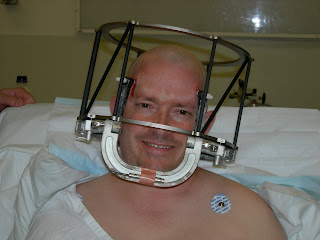
In full head gear

Post Op 1

Post Op 2

Back in the ward with my big pillow

The head wound two days on

The wire lumps just prior to stage 2

In post op after stage 2

The stage 2 wound. They wouldn't shave my whole head, even though I asked them to.

The big wound without staples

Chest wound I got in the war

Close up


Tuesday, May 18, 2010

Stimulated and Turned On! Part 3

Emotion that I have not shared with any of you so far are worry and a little frustration. They are not positive, but they are there and need to be confronted. When Dr Peppard first turned on the stimulator. At first I was relieved that there was a benefit and that I no longer had to deal with the problem of my tremor. However, there were also side effects, the worst one of which is a lack of co-ordination.

It is hard explain, but some things are easier but others are harder. For example, drinking a glass of water or something like that is easier, but walking is harder. I cannot walk in straight lines easily, and I find it hard to sometimes avoid obstacles such as furniture or toys that the kids have left on the floor. Even a doorway can be miscalculated and hit with my shoulder or something. However, when I turn it off the side effect goes away.

So, from my point of view there are two things I to work out, and both of them will take time. First, with assistance from Dr Peppard I need to find the very best settings for my stimulator and also get used to it. Secondly, I need to learn which setting to chose for my stimulator depending on the task I am doing or the situation I am in. When I start to figure these out I will let you know.Until next time, stay well:)


Saturday, May 8, 2010

A Question via Facebook

I got a question via facebook today, and it is a very good one. The question was what is the operation actually for? For me, I am caught up right in the middle of it all, so I take some things as common knowledge and what seems quite obvious to me can be quite confusing for others. Please, if anything perplexes you, feel free to ask.

Now to answer the question. I have a couple of neurological conditions but the one that they are treating with the deep brain stimulation is Essential Tremor (ET). ET means that you have uncontrollable shakes when you go to use your fine motor skills. It is classified as a degenerative movement disorder along with other ailments like Parkinson's and Tourette's syndrome and is actually the most common in the category. For me it is a problem I have had since I was a teenager, but the tremor was very mild back then and it never bothered any of my functionality. In fact the worst side effect I had back then was other kids picking up on it and having a joke at my expense.

For about ten years it stayed that way until in 2001, about a year after I was diagnosed with Peripheral Neuropathy (CIDP) it started getting worse and tasks like writing or drinking with one hand became harder and started to bother me. I was already seeing a neurologist at the time, so I asked him about it. He did some tests and wrote me a script for inderal (A beta-blocker normally used to control blood pressure.) That did the trick quite nicely for a while, but as time went on, the drug became less effective and so doses were increased and new drugs were introduced which bought new side effects with them.

It was five years ago when the surgery was first proposed to me, and my immediate reaction was "are you kidding?" Clearly, I was not ready at the time for the surgery, but time went by and about three years ago, I all but lost the ability to write, and drinking became a strictly two handed affair. However, I still was not ready for the surgery until about a year ago, so I organised to see the neurologist who specialised in tremor to revisit the idea of the surgery. That leads us to where we are now.

If you thinking I am mad having the surgery read my post entitled "My Brain Needs Stimulating" dated 23/3/10. Well, I hope this answers the question. Until next time, stay well:)

Monday, May 3, 2010

Expect the Unexpected


I must admit, I have been a little ambitious with what I expected to accomplish with my blog. My last post about the day of my surgery I expected to get out on Saturday, the day after. This post about the initial stages of recovery I expected to get out Sunday and it is now Monday, but I shouldn't be surprised, this is brain surgery, and even though I haven't had much pain I have been really tired. I have been sleeping more than 16 hours a so I guess it's not surprising that I have not been posting my blog with free flowing regularity.

The point that I want to make today is about recovery. No matter how much preparation is done for a surgery, things are never quite what you expect. I researched this procedure in greater depth than I did my final year uni exams, but there were still a few surprises. The first as I already mentioned was how tired I've been. In other surgeries I have had the pain has been worse, but after I recovered from the initial anaesthetic I wasn't tired, which normally meant that as I slept all day, and was then awake all night.

Second was the boots I had to wear. I was aware that they would make me wear compression socks as this is general practice for all admitted patients almost anywhere these days. However, I didn't expect the sequential compression boots I was wearing. These boots systematically filled up with air, a bit like a blood pressure cuff, in order to promote circulation and prevent blood clots. To start with they felt quite nice, like a gentle leg massage, but as time went by they began to itch and my legs got hot and sweaty inside them. Had I known about them I might have been able to prepare. Maybe use some powder or cream, or wrap a towel around my legs inside the boots.

A more worrying problem I had was with my speech. I knew that the stimulator could effect speech, but I thought that that only happened when it was turned on. However, in post-op I noticed that my speech was slower and slurred some what. This could have been a side-effect of the drugs and only short term, but I feel that there was more to it than that, and the side effects were still felt over a day later. Everyone tells me that they could not notice it, and I believe that as time has gone by and the swelling has gone down it has got better. But the fact that it was unexpected is rather disconcerting.

Finally, my last unexpected surprise was the size of the cut. When researching the procedure I found pictures of scars that were only an inch long on either side, so you could understand that I was a little distressed when I saw the wound with over 30 staples. I does not really bother me, but I would much have preferred to know before the procedure so I knew what to expect. The doctors had always played down the size of the incisions and coupled with my own research had led to misinform me. This brings me on to a much larger topic, but I will handle that later. The general rule is however, as with many things in life, it will never be quite what you expect.

Well, apologies once again. I said at the start it was Monday, and although I started writing it on Monday it is now Tuesday evening (apology exemption for US readers, who should still get this on Monday) but the days go by quickly when you sleep 16 hours a day. Next time I'll simply give an update on how I am. Until then, stay well:)

Saturday, May 1, 2010

Recovery Time

First, thanks to my wife for allowing me to dictate yesterdays post to her. I never would have been able to get it out there without her. Well, yesterday was a very busy day for me, so bare with me, because today's post is probably going to be a long one. I was woken up at 5.45am which didn't really bother me because I couldn't sleep very well anyway. The nurses were keen to get me ready straight away as I was the first patient of the morning. So I had my shower with some special anti-bacterial lotion, and once I had dressed myself in the highly fashionable hospital garb, it was time for that very long trolley ride to the OR.

Once I got to the OR the first people I met were the anaesthetist, Dr Nikki Tan, and her assistant Luca. They were both very friendly and reassuring which was great as I have to admit I was really quite nervous at the time. I have been in the situation waiting for surgery before, but this was different. Having a doctor sticking pins into your brain is a scary thing to think about. It is like they are playing with your very soul, so the friendly assurances were extremely welcoming.

After a short wait the surgeons assistant came in to give me a hair cut and then Nikki started running the sedatives in through my IV and when I woke up my hair was completely gone and Prof Bittar was attaching the stereotactic frame. I must admit that although local anaesthetic had been injected all over the process was quite unsettling. There was a lot of pressure like having my head stuck in a vice, and since I was asleep for the head shave I wasn't quite sure why they didn't keep me asleep for that. The local anaesthetic felt weird as well. Although I couldn't feel anything I also could not frown or make any facial expressions above my eyes. I guess that's what botox would feel like, so remind me never to have it.

With the frame now securely in place I felt like Frankenstein as he was awoken by the doctor for the first time. It was extremely heavy, and uncomfortable on my neck as there was uncomfortable gap between my neck and the pillow. However, before I had too much time to think about it the OR was evacuated as we all headed down to radiology so I could have a CT scan. The trip was long and I certainly got some interesting stares from passers by. The CT scan took very little time and then I was escorted back to the OR by the same entourage of about ten people. Once there the sedatives were ramped back up and I fell back to sleep.

When I woke back up the frame had been wrapped in plastic to isolate the top of my head and they were ready to start testing the first implant. I kept hearing the doctor describing the position of the implant from the target and when he was happy with the position they tested it out. They tested the left side of my body first which meant that the first implant went in the right side of my brain.

For the testing, my neurologist, Dr Richard Peppard, was also there, and instructed the surgeon what level the stimulator was set to. The first time they fired it up I felt a tingle in my fingers then, amazing. My hand stopped shaking. I can't explain what happened, it was simply remarkable. My hand was still and I had no idea why. All I can say is that all I could do was smile and laugh. I felt overjoyed, but as soon as I started to become accustomed to the feeling they turned it off and started to work on the other side.

The right side of my body wasn't quite so simple. When they turned the stimulator on my tremor did stop, but my voice became very slurry and the right side of my face started to droop to the point where I couldn't open my eye. This feeling was really quite scary because I also became very dizzy, but as soon as the machine was switched off the side effects subsided. I started to feel rather agitated at that point. After the great results on the left side I wanted to get the right side done and the frame off me head, but hey played around with different depths and frequencies until they were happy with the results. Prof Bittar then offered me the choice of having stage two of the surgery done there and then or waiting a week or two. I wasn't bothered which way he went, but one of the frame clamps was attached where he would run the power line to the battery, which increased the risk of infection slightly, so I left the decision to him and he decided to wait. After which it was back to sleep and the next time I woke up I was in recovery.

In recovery it felt like the stereotactic frame was still on my head which was quite sore. Other than that I felt fine, so after an hour of constant monitoring it was back to CT for one more scan (this time without the entourage of medical staff) before returning back to the ward.

So, how did I feel on return to the ward. The main emotions I had were both relief and worry. I was relieved that it was all over and I knew that at least on the left side I was going to get a really good result. Worried because my speech was still slurry and I hope that this wasn't going to be a more permanent side effect. Fortunately, over time this has subsided and at least the hardest and most dangerous part is over now. In my next post I will let you all know how I am going recovering. I have also attached a few photos for your amusement. Until next time, stay well:)


Photo of myself wearing the stereotactic frame

The incision


Wednesday, April 28, 2010

Two more sleeps...

First, welcome to all the new followers! I have gone from two to eleven in the last two days. And thanks also for all the great feedback that I have been getting. I am glad to see that you are all enjoying it.

So I now only have two days to go until the big op. I feel pretty much the same as yesterday, except for a chat I had with my therapist. She wanted to discuss the possibility of it not working and how I would cope. Although it is an uncomfortable thought I do feel it is really important. I am certainly not entering into this expecting it to fail, but if it does the preparatory work that I do now will make things easier afterwards. Talking it through with Josie was also the right thing to do as she is good at making the conversation as easy as possible.

To tell you the truth though, I really don't know how I will feel if it doesn't work. In the short term I know I will be devastated, but how long will it take to accept it? Where will I be able to find the energy and the passion to move forward? Or find myself a role in society where I will be able to contribute? I hear many of you saying that you do contribute, but these feelings come from within, and anyone that has battled with depression or anxiety knows that the war wages within. Hopefully I will not have to fight this one, but I do know that if I do I need to prepare now. I have had enough bad news in order to know that.

Well when I planned this post I was going to finish there, but that just seems like a real low point. So I will leave you with this. We do not have surgery to get worse, we do it to get better. There are risks with any operation, but we need to be positive. I am doing this to get better and if at the end of the day it doesn't work at least I will know. If I don't do it, there is no chance of getting better and I will always be left wondering. Until next time, stay well:)

Tuesday, April 27, 2010

I Feel Great!

I have just finished updating my mood on patients like me and I have been surprised to find that my last five entries have all been 'good'. www.patientslikeme.com is a great website for people with chronic ailments, especially when it comes to mental health. I will review it in more detail in a later blog, but I want to focus on the mood mapping. It allows you to rate your mood on a scale of one to five (one being bad and five being great). It is fairly crude, but a great early warning system for your mental health. Oh, I hear you asking what is a rating of good. Basically, good is four out of five.

Now I have touched on my mood being good in previous posts, but I have to say I was surprised, and I did not realise that the decrease in the number of stresses would be so profound. Don't get me wrong, the stress from the impending surgery is massive! But just having one stress to deal with is so much easier. I really feel that I am learning a big lesson here, and it is a great one to learn for future management of my own mental health. As of yet I haven't figured out how to apply this new found knowledge, but when I do I will be sure to let you know. One thing for certain is that it will be a process.

So, other than the trivial day to day tasks, my main focus is on the surgery. But that is nothing new, I have told you all this already. I have told you where exactly my concerns and anxieties lie, but I haven't told you how this is making me feel. This is probably because I am not sure. Yes, there is a strong level of anxiety and worry, but there are also a bunch of emotions that are thrown in the mix, some of which I didn't even know existed. I would say I am definitely experiencing mixed emotions.

So far, the best I can come up with is that I am at a crossroads of my life. Something is going to happen on Friday, and there could be a number of different outcomes. Each potential outcome has a different emotion associated with it, so my feelings are changing with each new thought. However, I think that half of the ease of the situation is that there is nothing that I can do about it. It will be what it will be, so all I can do is wait, enjoy my family and friends and try and have some fun. I've gotta say, I have really loved the last three days with my family. Until next time, stay well:)

Last Weekend Before Surgery

First, I must apologise. A couple of posts ago, I said I was done with my medical obligations until the day of my surgery. Oops. Friday I was back in the hospital for my routine intragam treatment (that I confess I forgot about completely) and I also have to see my GP as my surgeon informed me last week that my referral had run out. It was kind of opportunistic anyway as I can get him to update my drug regiment chart and medical history report. This makes life easier as when I am filling out those damn forms I can just write see attached in the relevant sections and attach a copy to the back.

Anyway, I promise that barring any unforeseen circumstances I will have then had my last medical obligations. So where am I know? I have officially finished up at work, and here in Australia we are currently in the middle of a long weekend for ANZAC Day. The extra time is great, and although there are many positives, there are also negatives. I have almost eliminated all stressful elements from my life now, which is great, but we still have that one massive commitment to deal with. Yes, my surgery. So I have really busied myself playing with the family, having fun with friends and working on this blog. It is a wonderful distraction too. However, when I stop, my mind always drifts back to the surgery. However, being just one stress to focus on it does feel easier. Right now I feel as though I have boarded up the windows, reinforced the structure to my house, and now I am just sitting on the porch waiting for the hurricane to hit.

I know I am prepared, it is a question of simply filling in the time between now and the surgery. Rest assured, I will let you know how it goes. Until next time, stay well:)

Wednesday, April 14, 2010

Lots to think about... Part 4

Surgery affects the patient more than anyone else, no questions asked. The statement itself is so obvious it probably isn't even worthy of mention. But it does give rise to a statement that isn't nearly as obvious but still very important, and that is that surgery affects a lot of other people as well as the patient. Your friends, family, work colleagues, carers and other aquaintances can all be affected, and as a patient going through surgery it can be very easy to ignore how they feel. It is important that you don't, and the best way to ensure this is to prepare before surgery.

For me, the people that matter most are my wife and children. After my surgery, and I have been discharged from hospital, it will be my wife that will look after me. So how can I help? Well, preparation is the key. The more I can do now to get everything sorted out the better. This includes having our will updated, making sure that all bills are paid so we don't have anything to worry about when I am sick, a number of frozen meals are prepared and things are ready for me on my return from hospital. I am lucky though, m wife is great and looks after most of the things around the house anyway.

As for the kids, that is a different story. Last time I had surgery I read my kids a book called "Ben goes to Hospital", which outlines the process of going to hospital and is tailored for children. They both seemed fine and happy until the next day (the day of my surgery). My daughter was very clingy and said 'dad, I don't want you to go to hospital, you could die'. I assured her that I was not going to die, and that I had to go to hospital. The main point is they were not OK. I've since done a little research and decided that the I should be perfectly honest with them, be available to them when they want to ask questions even if it is a little inconvenient, but play it down as being routine. Kids understand more than we think, but there is know need to dwell on the negatives.

I have been overwhelmed by the number of friends and family who have shown genuine concern. I have been truly touched, and the fact that so many people care means an awful lot to me. Most people end up saying the same three things.
  1. Please let me know how it goes?
  2. Is there anything I can do to help?
  3. I wish you all the best and hope it all goes well.
Honestly, it is nearly impossible to individually catch up with so many people but luckily for me we live in the age of social media. I will keep all my news posted here, so I have been telling everyone just to read this blog. As for there help, it is great to know so many people are willing to help but in most cases it won't be needed. Still it is very comforting to know that I do have so much support that I can count on if needed.

Lastly, me. This is a huge thing for me. With out a doubt the biggest surgery I have ever had. So what do I need. Well, I have spent a lot of time researching the procedure, as I like to know exactly what is going on. I have also got myself in a position where my business can run without me, and had my will updated. Lastly, I have taken my family on holiday, and spent a lot of time catching up with friends and family before my surgery. Once I have done this I should be ready. I hope. Until next time, stay well:)

Saturday, April 10, 2010

Lots to think about... Part 3

If you are currently sick and laid up in either hospital or at home work is probably the last thing on your mind. I hear you. Really I do. When I was in hospital for my three week lay up I couldn't care tuppence about work, and I run my own business! All I wanted to do was get all the tubes out of me, get home, get better and sleep in my own bed.

However, once I was better, work came back into focus and and I had a mountain of stuff to get back to that was overdue and in urgent need of attention. I was lucky that I had some great staff doing a great job, but there was some tasks only I could do and the lack of focus I had in the aftermath and the shoddy paperwork that ensued still haunts me today.

So how can I make this surgery experience different? Well first, I have come to the realisation that I had been struggling at work for quite some time, and carrying on trying to muscle through it was doing nobody any favours and was effecting my health. So after my surgery I will be taking an indefinite period of time away from my business which will help me to get my health back on track.

However, I still need to make sure that I plan my departure properly. I have to train people up to do the jobs that I do, and put certain checks in place to make sure that the money and banking is properly administered. Once I have this the way I want it I can head off for my surgery knowing that I have everything taken care of and there will be one less stress in my life when I am recovering. Next time I will talk about getting things ready from a personal perspective. Until then, stay well:)

Tuesday, April 6, 2010

Lots to think about... Part 2

Bad news for sick people. It is statistically proven that if you have one serious chronic ailment, you are more likely to get a second. And yes, that includes me. I regularly see doctors, and get treated for cystinuria, CIDP, depression and essential tremor. I believe that in some way they are all linked, but none the less, they all require a different set of doctors and treatments.

Now with my up coming surgery, I am being treated for only one of these diseases (essential tremor) and during this process, this disease will not be neglected. However, the others might be. When I had my big surgery four years ago, I missed two doctors appointments and one treatment for my CIDP. This had the potential to be very counter productive and even dangerous. Doctors set your appointment schedule so they can best monitor how your disease is behaving and intervene early enough if something is wrong. Your treatment schedule is designed to achieve the best results. Luckily in my case, no permanent damage was done. But I don't want to put myself in that situation again.

So how can you prevent such a scenario? Well, firstly there is a lot you can do with the timing. I have seen or am seeing my doctors shortly so I will not have to see any of them for at least a month after the surgery. This way, I don't have to worry if things take a little longer than expected at the hospital. I have also timed my treatment for one week before the operation, so I won't need another one until three weeks afterwards.

The second thing that I can do is communicate with my doctors. If they know what is happening they can make decisions to alter my treatment if necessary. My wife is across all my doctor appointments, so if need be, she can make the arrangements. Well, next time I will talk about the importance of tieing things up at work. Until then, stay well:)

Friday, April 2, 2010

Lots to think about...

So, in 31 days time I will be spending the night in hospital, awaiting the morning of my surgery, and aside from the doctors appointments in the interim, there is a long list of things that need to be done outside of preparing for the surgery. This one really caught me out about four years ago, when I went in to hospital to have a kidney stone removed in a procedure that should have kept me out of action for a week. However, things did not go to plan, and a three day hospital stay became three weeks!

In a three month period I had 23 nights in hospital and seven operations requiring either anaesthetic or sedation. It took four months to fully physically recover, and today I think that I still carry some mental scars that I don't know if I will ever recover from. So for four months I pretty much did nothing accept recover from surgery, and whilst I did that the rest of my life stopped. Unfortunately, the world didn't, which left things undone, or others to reign in the slack. I was lucky though. I had (and still have) many good people around to help.

So, in order to avoid a repeat performance I have decided to be prepared and get as much done before the surgery as possible. Please bare with me, in the last four years I have not had a surgery that has warranted such preparation, so for me this as much a learning process as it might be for you reading this.

I have broken the areas of my life down into four areas that I believe require attention. They are:-

  1. Other medical (treatments not relating to DBS)
  2. Work
  3. Family and self
  4. Personal obligations
Just from planning my blog I have found that most things I need to worry about will fit into one of these four broad categories. Next time I will talk about what I need to do to prepare with my other medical issues, and why t is important. Until then, stay well:)

Wednesday, March 31, 2010

OK, I'm officially psyched out.

Well, after two psychologists appointments in two days, I think that it is safe to say that I am officially psyched out. Last time I talked to you about the clinical psychologist, and today it was the turn of the neuro psychologist, and as yesterday, I had a list of questions that I wanted to know:-

  1. What were all the purposes of this appointment?
  2. What exactly are all the tests that you will run?
  3. What are the disqualifying factors?
As this procedure was not invasive I wasn't really concerned accept for one thing. Could this appointment exclude me as a candidate for surgery? The short answer was yes, but as it happened I had nothing to worry about.

So, what happened? First, we started with the general chit chat. I asked her my questions and she gave me a brief explanation of what we would do. From then on it was all testing. There were tests for my memory (both long and short), cognitive reasoning, IQ, problem solving, mental stability, and mental health. I was a little bit annoyed by this last section. She asked some very strong questions, such as "What do you think the worst thing that could happen is?" and "What will you do if the procedure doesn't work?" and then we explored these further in quite a lot of probing detail. She also didn't like my answer to the former, when I didn't acknowledge death as the worst thing that could happen. The fact is, the way I see it is I could have a stroke and live 40 years as a vegetable. She also didn't understand when I said I did not fear death. Don't get me wrong, I love life and I am not looking to hasten my demise or take ridiculous risks, but death doesn't scare me and I don't think she quite understood this. I also felt that this was covered by the clinical psychologist and I didn't really want to cover it again.

Anyway, at the end of it, I got the seal of approval to go ahead, and a full set of psychological benchmarks to compare against, God forbid something does go wrong with the surgery (which is the main reason why we did this). Now we are just a month out from my surgery I will take you through my checklist for getting ready in my next post. Until then, stay well:)

Friday, March 26, 2010

The Games Begin!

Well, today felt like the first official day in the lead up to my brain surgery. Being quite a major operation, I have a few tests and consultations to attend in the next few days. They are:-
  1. Consultation with a clinical psychologist
  2. Consultation with a neuro psychologist
  3. Consultation with neurologist
  4. Sedated MRI
  5. CT scan
So today I trotted off to the clinical psychologist. I was sort of crabby before I got there as I already see a clinical psychologist, and I couldn't see the point in consulting another one. I would have thought that a report from my psychologist would have been enough, but the surgeon insisted I saw theirs, so off I trudged. After 15 minutes looking for a parking space (then giving up and going to the secure parking) followed by 45 minute wait for the psychologist, I was a little cranky.

But finally I got in to see Victoria Miller, a smartly dressed, professional looking lady, but at the same time a very friendly, comforting and disarming demeanour. My first impression was that she was very good at her job, and she didn't prove me wrong. Seeing as though I had struggled to see the relevance of this consultation, my list of questions that I had prepared was relatively short. They were:-
  1. What do you wish to achieve from this session?
  2. Is it really necessary?
I asked the second question first. I wanted to get it out of the way, but I did not want to appear cynical. So I asked if this was something that my current psychologist could do and did I really need to be here? Her answer was that she probably could, but Precision Neurosurgery like to get their own assessment. So what was the purpose of the session?:-
  1. Make sure I have no underlying undiagnosed mental disorders like Bi-polar or depression. Since I had already been diagnosed with depression, this really was not much of an issue. They needed to know I was being treated, and as I was there was no need for concern.
  2. Make sure I had a strong support network of family and friends and offer an extra avenue of psychological support if needed. I have a very supportive wife and a close family, and if that failed I still had a good network of friends I could rely on, so not as issue for me.
  3. Make sure my expectations from the surgery were realistic and what if it failed to work or went wrong. Well I will focus on my fears from the surgery another time, but I fairly sure she was happy with my answers.
So the big question is was the session necessary? I would have to say yes, it was, but probably not for me. The doctors need to find out these answers, and if I gained anything from the session, it was the comfort that the doctors were being thorough, and they cared about my general health (both mental and physical) as well as simply trying to cure my tremor. I guess that in itself was simply enough to make the consultation worth while.

Well, tomorrow it is off to the neuro psychologist. Rest assured I will let you know how it goes. Until then, stay well:)

Wednesday, March 24, 2010

My Brain Needs Stimulating

Hi all, I hope you are all in good health. My last four posts have all been about preparing for surgery in order to make you stay as smooth as possible and assist recovery. I was then going to write about how to cope with situations whilst you are actually in hospital. However, I will be having Deep Brain Stimulation surgery for essential tremor in about six weeks and have just started going through the testing process in order to be prepared for my day under the knife, and I thought it would be extremely valuable to write about my experiences as they happened.

So I feel a good place to start my DBS series is to answer the question "why am I having it?" After all, my life is not in danger without the surgery and my friends and family think I look fine and interact with society perfectly well and they understand my affliction and it doesn't bother them. Well it bothers me! I live with it 24/7 and I want it gone. I think that the best way for people to get a better understanding of what a tremor patient has to live with is to give you a snap shot of my morning. You can try it if you like:-

  1. Alarm goes off. Accidentally knock it off the bed side table trying to turn it off.
  2. Shower - Nearly scold then freeze yourself trying to get the water temp right.
  3. Shower - Drop soap three times.
  4. Shower - Poke self in eye trying to wash hair and face.
  5. Shaving - Yeah, you can figure this one out yourself.
  6. Teeth - Put too much tooth paste on brush, and get some on the bench.
  7. Teeth - Clean up bence.
  8. Teeth - Ouch! Poke self in back of mouth with brush.
  9. Clothes - Try buttoning shirt, give up and wear a t-shirt.
  10. Clothes - Slip-on shoes only, laces too hard.
  11. Kids - Dressing son too hard, send to his mother.
  12. Breakfast - Spill milk on floor
  13. Breakfast - Clean up milk (kids are getting impatient)
  14. Breakfast - No tea or coffee. Only drinks that are out of the bottle
  15. Kids - Accidentally hit daughter on her head with the hair brush (tears)
  16. Phone - incorrectly enter PIN twice, so get wife to do the third and final try.
  17. Leaving - Unlock door to house accidentally dropping keys in the process.
Finally I have left the house. My work day is yet to begin and I am already exhausted. I haven't even tried to write or type or even eaten properly. As with many diseases, especially movement disorders, essential tremor governs the things you buy, the activities you partake in, where you go, the choices you make and the people you see. Arresting the tremor is not simply a convenience thing, it is a fundamental shift in the quality of ones life and unshackling the burden that enslaves its sufferers everyday.

For fellow sufferers of movement disorders, I hope that this helps validate what you have always known, and for carers I hope that this will help you better understand what a sufferer has to go through and why they make the decisions that they do. Next week I am off to the clinical psychologist and neuropsychologist for assessment for DBS. I will let you know how it goes. Until then, stay well:)